Traditional static analysis tools scan smart contracts like a spell-checker scans documents. They look for known patterns of vulnerabilities without understanding what the code is actually trying to do. Here's how context-aware call flow analysis changes the game.
The Problem with Traditional Static Analysis
Traditional static analysis tools scan smart contracts like a spell-checker scans documents. They look for known patterns of vulnerabilities without understanding what the code is actually trying to do. This approach creates two critical problems:
False Positives That Waste Developer Time
When a tool flags every external call as a potential reentrancy risk without understanding the business logic, developers spend hours investigating warnings that turn out to be intentional design choices. A withdrawal function that deliberately allows callbacks isn't necessarily vulnerable, but pattern-based tools can't tell the difference.
Missed Vulnerabilities in Complex Execution Paths
More dangerous are the vulnerabilities that pattern matching completely misses. When a vulnerability requires understanding how three functions interact across two contracts under specific state conditions, simple pattern matching fails. The exploit path exists, but the tool never sees it because it's looking at functions in isolation.
Introducing Context-Aware Vulnerability Detection
SafeStack AI's call flow analysis performs a three-phase deep reconnaissance of your smart contracts before scanning for vulnerabilities. Instead of blindly matching patterns, our system first understands your code's architecture, purpose, and attack surface, and then detects vulnerabilities with that context.
Phase 1: Intelligent Call Graph Mapping
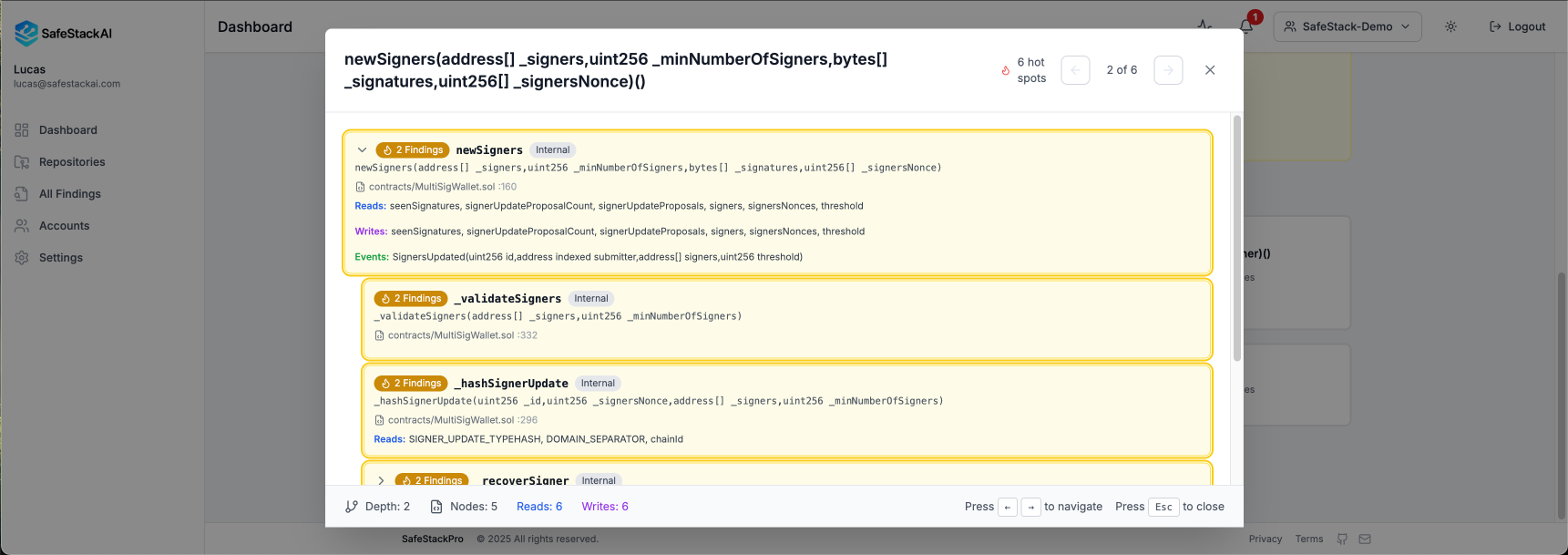
Intelligent call graph mapping traces execution paths across your entire smart contract system
The foundation of context-aware detection is understanding execution paths. Our system automatically:
Traces every execution path from all public and external functions
Maps complete function call chains across all files, including imports and libraries
Builds recursive execution trees showing exactly what gets called and when
Queries the Abstract Syntax Tree (AST) and navigates following the execution flow for code analysis
This isn't just documenting your code. It's creating a complete map of how value and state flow through your system.
Example:
In a DeFi protocol, we don't just see withdraw() calls _transferETH(). We trace the complete path:
This is where the magic happens. The enriched call flow analysis is passed to all vulnerability detection agents, enabling:
Targeted Scanning: Focus on actual risk areas
Instead of scanning every line for reentrancy patterns, we focus on the specific execution paths that: (a) make external calls, (b) handle value transfers, and (c) modify state. This reduces scan time while increasing accuracy.
Context-Aware Detection
When we see an external call before a state update, we don't just flag it as "potential reentrancy." We understand:
Is this a withdrawal function (high risk) or a notification callback (low risk)?
Does the function handle user funds or just emit events?
Are there existing guards that our pattern matching might miss?
Complete Coverage
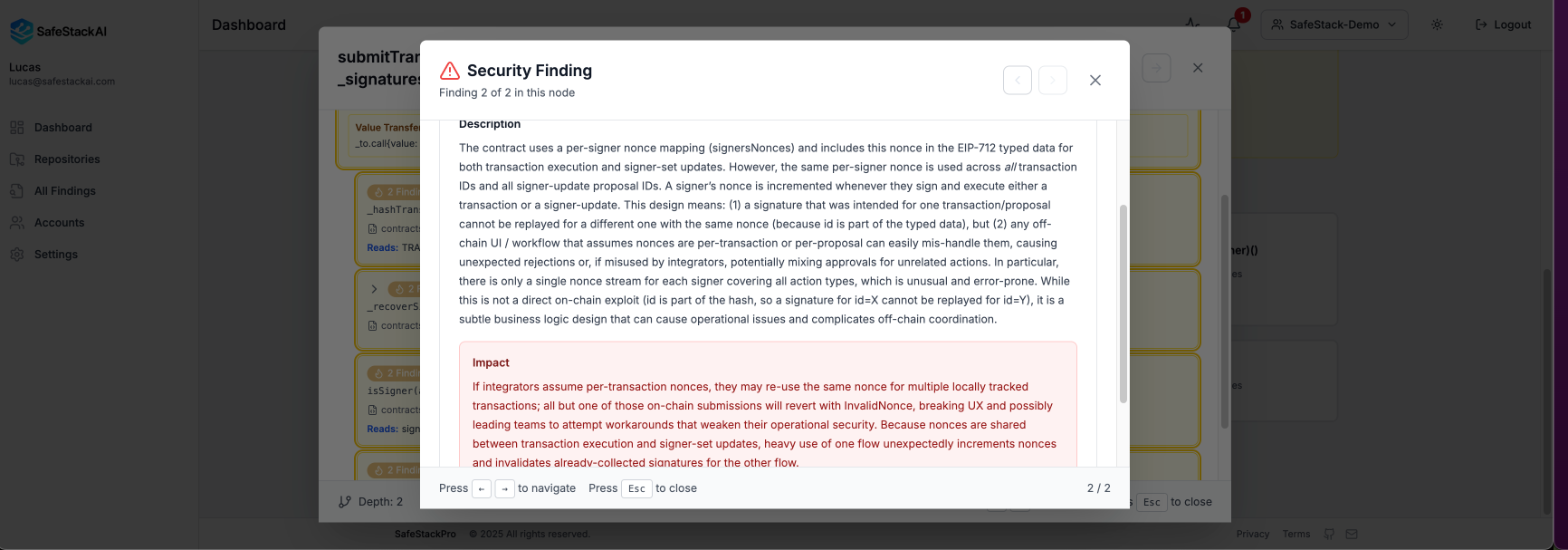
Context-rich vulnerability detection shows complete execution paths and attack vectors
Cross-contract and cross-function vulnerabilities only become visible when you understand complete execution paths. Our analysis traces calls through multiple contracts, identifying risks that emerge only when specific functions are called in sequence.